
Views: 0 Author: Site Editor Publish Time: 2026-03-07 Origin: Site


Selecting the right hospital bed is one of the most important decisions in patient care, whether for hospitals, nursing facilities, or home use. From our experience at Quzhi Industrial Co., Ltd., many customers begin with a simple question: should they choose a manual or an electric hospital bed? The answer depends on more than just price. It involves understanding patient needs, caregiver workload, long-term usability, and overall comfort. In real applications, the right choice can improve both care efficiency and patient recovery experience.
A hospital bed is much more than a sleeping surface. In modern care settings, it functions as an important part of the treatment and recovery environment. Unlike a standard household bed, a hospital bed is designed to support patient positioning, safety, mobility, and caregiver convenience. Its purpose is not only to provide comfort during rest, but also to make daily care tasks more efficient and safer for both the patient and the caregiver.
In practical use, the design of a hospital bed can directly affect how easily a patient can sit up, change posture, get in and out of bed, or receive medical attention. For caregivers, a well-designed hospital bed reduces unnecessary lifting, awkward movements, and time spent on routine adjustments. This is why modern hospital beds are considered essential medical support equipment rather than simple furniture.
Today’s hospital beds are expected to offer several practical adjustment functions. The most common include backrest adjustment, leg elevation, and height adjustment. These features allow patients to move into more comfortable or medically appropriate positions during rest, treatment, feeding, or recovery. A raised backrest can help with breathing comfort, reading, eating, or speaking with visitors. Leg adjustment may support circulation and reduce swelling. Height adjustment helps caregivers perform tasks more easily and can also make it safer for patients to enter or leave the bed.
In addition to adjustment functions, modern hospital beds are also expected to support safety and hygiene. Side rails, stable frames, smooth surfaces, and easy-to-clean materials all play an important role in daily use. For long-term care, these details become especially valuable because the bed is used repeatedly and often continuously.
Choosing the right hospital bed has a real impact on care quality. If the bed does not match the patient’s condition or the caregiver’s working needs, everyday care can become more difficult. A bed with limited adjustability may leave the patient uncomfortable or make repositioning harder. A design that is difficult to operate can also increase caregiver fatigue, especially when adjustments must be made several times a day.
This is why understanding the difference between manual and electric hospital beds matters from the start. The right choice can improve comfort, support safer handling, and create a more efficient care experience overall.
A manual hospital bed uses hand cranks to adjust different parts of the bed frame. Caregivers turn these cranks to raise or lower the backrest, adjust the leg section, or change the overall height depending on the model. The system is mechanical rather than powered, which means it does not rely on electricity for normal operation.
Manual hospital beds are often chosen for settings where basic care functions are needed at a more controlled cost. They are commonly used in short-term care, recovery rooms, temporary care environments, and facilities where power access may be limited or where simple operation is preferred.
One of the main advantages of a manual hospital bed is affordability. It usually has a lower purchase cost than an electric model, making it attractive for budget-sensitive projects. Manual beds also tend to have a simpler structure, which can make maintenance easier and reduce the risk of motor-related issues. In many standard care situations, this kind of bed provides dependable performance without unnecessary complexity.
At the same time, manual beds require physical effort for each adjustment. When patients need frequent repositioning, this can increase caregiver workload and reduce efficiency. Adjustments are often slower than with electric systems, and fine positioning may be less convenient. For care environments with higher daily demands, these limitations are important to consider.
Electric hospital beds use motors and control panels to adjust positions. With the push of a button, caregivers or patients can change the bed configuration quickly and smoothly.
Electric beds range from semi-electric models, where only some functions are powered, to fully electric beds with complete motorized control.
Electric hospital beds offer convenience, precision, and ease of use. They reduce physical strain on caregivers and allow patients to adjust their position independently in some cases.
The main drawbacks are higher cost and dependence on a power source. Maintenance may also be more complex compared to manual beds.
To better understand the comparison, the table below summarizes the main differences:
Feature | Manual Hospital Bed | Electric Hospital Bed |
Adjustment Method | Hand crank | Motorized control |
Ease of Use | Requires effort | Easy, push-button operation |
Cost | Lower upfront cost | Higher initial investment |
Maintenance | Simple | More complex |
Patient Independence | Limited | Higher |
Caregiver Workload | Higher | Reduced |
This comparison shows that the decision is not just about budget, but also about daily usability and long-term care efficiency.
Electric hospital beds provide smoother and more precise adjustments, which can improve patient comfort significantly. Patients who need frequent repositioning benefit the most from this feature.
Frequent position changes help reduce pressure points and improve circulation. Electric beds make it easier to adjust positions regularly without effort.
In some cases, patients can control electric beds themselves, which improves independence and overall experience. Manual beds do not offer this advantage.
Manual hospital beds require caregivers to manually adjust positions, which can be physically demanding over time. This is especially important in facilities with a high number of patients.
Electric beds streamline daily care tasks, allowing caregivers to focus more on patient care rather than mechanical adjustments.
Reducing physical strain can improve caregiver productivity and reduce fatigue, which is a key factor in long-term care environments.
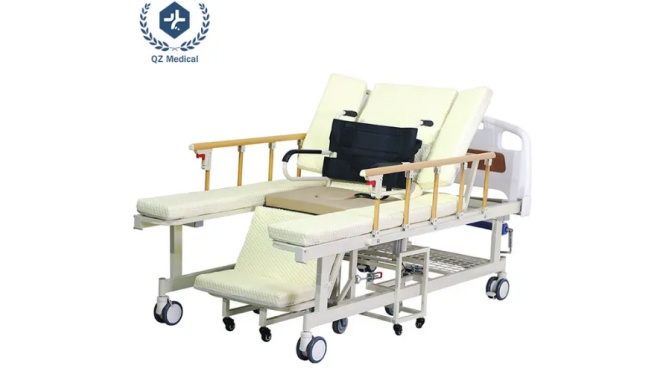
Manual beds are ideal for projects where cost control is a primary concern. They provide essential functionality at a lower price point.
If patients do not require frequent repositioning, manual beds can meet basic requirements effectively.
In locations where electricity is unreliable, manual beds offer a dependable solution.
Electric beds are more suitable for long-term care situations where comfort and ease of use are critical.
Patients who require frequent adjustments benefit greatly from electric systems.
Hospitals and advanced care facilities often prefer electric beds for their efficiency and functionality.
While electric hospital beds have a higher upfront cost, they can reduce labor effort and improve care efficiency over time.
Manual beds have fewer components and are easier to maintain. Electric beds require more attention but offer greater functionality.
When evaluating cost, it is important to consider not only the purchase price but also operational efficiency and long-term usability.
A hospital bed is more than a piece of equipment; it is a key part of patient care and recovery. Manual beds offer simplicity and cost advantages, while electric beds provide convenience, comfort, and efficiency. At Quzhi Industrial Co., Ltd., we support healthcare providers and distributors by offering reliable solutions tailored to different care scenarios. As global conditions continue to influence raw material and logistics costs, including impacts linked to Middle East tensions, pricing may fluctuate. Planning procurement in advance can help secure better value and availability. If you are evaluating a medical bed solution, we welcome you to contact us for further information and support.
1. What is the main difference between manual and electric hospital beds
Manual beds use hand cranks for adjustment, while electric beds use motorized controls for easier operation.
2. Which hospital bed is better for home care
Electric hospital beds are often better for home care due to ease of use and improved patient comfort.
3. Are electric hospital beds worth the higher cost
Yes, for long-term care or high-dependency patients, the benefits in comfort and efficiency often justify the cost.
4. Can manual hospital beds meet basic medical needs
Yes, manual beds are suitable for basic care situations where frequent adjustments are not required.


